СТРУКТУРА ЕВАНГЕЛИЯ ОТ ИОАННА

(Вы можете скачать эту информацию в файл PDF на нашей новой странице «ЕВАНГЕЛИЕ ОТ ИОАННА»)   biblia

СТРУКТУРА ЕВАНГЕЛИЯ ОТ ИОАННА


Пролог: 1:1-18           Вечное Слово вошло в мир.


Часть 1: Свидетельство и Чудеса (1:19 – 12:50)

1:19-34: Иоанн свидетельствует что Иисус есть Сын   Божий.

1:35-51: Иисус привлекает учеников.


Кана цикл, чудеса 1-3. (2:1 – 4:54)

2:1-12: первое чудо, вода в вино.

2:13-22: 2-е чудо, очищение и создание Храма

2:23-3:21:Никодим, перерождение в вечную жизнь.

3:22-36: последнее свидетельство Иоанна.

4:1-26: Мессия предлагает живую воду в Самарии.

4:27-42: Самарийская вера и свидетельство.

4:43-54: 3-е чудо, исцеление сына царедворца.

Continue reading

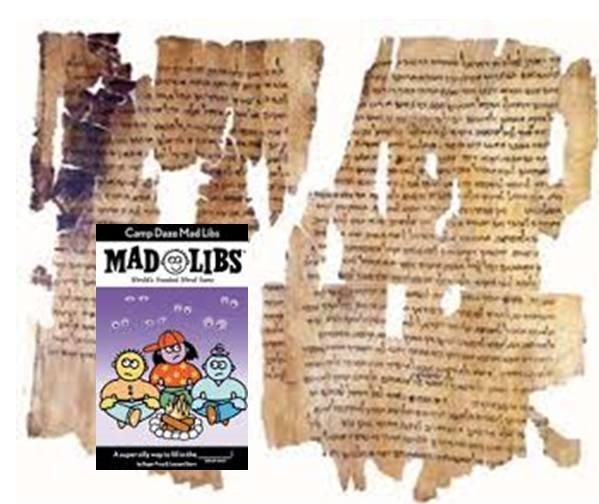
The Fragmentary Dead Sea scrolls as Mad-libs

I recently rediscovered an amusing four-year-old blog post from my dissertation writing days. I was studying the Dead Sea scrolls, and apparently I was studying a bit too hard. In the pages of the ancient Dead Sea scrolls, I was thinking of Mad-libs.  Here is the post :

I am currently at page 1221 of Martinez and Tigchelaar’s The Dead Sea Scrolls Study Edition (Martínez, Florentino García and Eibert J. C. Tigchelaar. The Dead Sea Scrolls Study Edition. 2 vols. Grand Rapids: Eerdmans, 2000).  Although the study edition is organized well, with the Hebrew on the left page and English on the right, the nature of the scrolls can make the reading a bit tedious. Many of the scrolls are fragmentary and have lacunae. These gaps make it difficult to discern what the author was trying to say.  I find myself trying to “fill in the blanks” when words are missing. At first, these attempts to fill in the blanks were serious endeavors.  I soon realized that I really had no idea what belonged in those gaps. dssmadlib

Filling in the missing words reminded me of “Mad-libs”.  When I was a child, my brother and I often took Mad-libs on long trips to pass the time.  Mad-libs are little booklets that contain stories with missing words (examples at http://www.madlibs.com).   The fun happens when someone fills in the blank spaces with random words so that something zany and silly results.  Call it unscholarly, but some of the Dead Sea scrolls make great Mad-libs.  Try it out for yourself!

11Q18 (11QNew Jerusalem)

Fragment  7:  [____] on all the offspring of the children of [___] . [____] who shall eat [____} for them around [____]  hundred and fifty [____] on [____].

Fragment 11: [____] its four [____] were four cubits high [____]   [____] the … near the wall which surrounds [____] its width is two cubits and its height is two cubits [____]  and all is pure gold which [____] . [____]  of columns, turning from door to door [____] from door to door in the city-wall [____][____] with panels [____].

To browse through pictures of the Dead sea scrolls, visit: http://dss.collections.imj.org.il/.

A Bibliography for the Spirit in the Gospel of John

Those who want to study the Holy Spirit in John’s Gospel are confronted with an enormous body of literature. Below is a bibliography of scholarly works (grouped into monographs, dissertations, and articles) that focus on the Spirit in the Fourth Gospel. To limit the scope, I have not included commentaries or general theologies on John; nor have I included systematic works on pneumatology unless they have a heavy focus on John’s presentation of the Spirit (even though these more general works should be consulted when studying the Spirit in John).  I also have not included anything before 1950. I have, however, included articles that examine specific passages in John that feature the Spirit. Due to the shear volume of material, I am sure some works have been left out. Feel free to post any suggestions in the comment section. dove
Continue reading

Free e-books from Logos.com

For those who are unaware, Logos Bible software is giving away a free e-book every day of the Advent season. These books can be downloaded even by people with the free version of the Logos software. The giveaways are not limited to Advent though.  Logos usually gives one free e-book away every month. Over the past few months I have downloaded commentaries, devotionals, lexicons, and some Greek primary sources . These e-books are of varying usefulness, but they are all searchable, which means you don’t have to thumb or scroll through pages to find (or not find) something relevant to your project.

I am not being paid to advertise for Logos; I simply wanted to make my readers aware of free stuff that will help them dig into God’s word. Here is the link: https://www.logos.com/christmas.  Merry Christmas!

Responding to God’s Christmas Flyer with Expectation – Simeon & Anna’s Example.

Stores seem to be advertising for Christmas earlier and earlier. The decorations, the sales, and the Christmas preparations begin long before Thanksgiving.  How many pre-Thanksgiving Christmas flyers did you receive? These flyers tell us to be expectant and prepared because our shopping hopes will soon be fulfilled. You may lament this pre-Thanksgiving Christmas advertising and want to return to “the good old days,” but realize that the first Christmas was actually advertised, and prepared for, centuries before the actual day.

When Jesus was born that first Christmas, he came to a people who were expecting God to send a savior, a.k.a. Messiah, because prophets had advertised the Messiah for centuries (the term “Christ” is just the Greek translation of the Hebrew word “Messiah”). Certainly some had given up waiting, and others did not really believe God would act, but there was a general expectation in Israel that God would one day fulfill his prophecies and send a deliverer.

The Jewish people expected the Messiah to establish God’s kingdom and restore Israel just as the prophets advertised. This Messiah would be very unique and set apart for this purpose. These numerous prophecies gave a certain amount of specificity to the Messiah.  For instance, the Messiah would be a descendant of King David because God promised David that he would always have a descendant to rule Israel. The Messiah, therefore, was often referred to as the “Son of David.” The people expected the Messiah to not just restore Israel as a nation-state but to reestablish the close relationship between God and his people in an everlasting way. Some of the prophecies that advertised the coming CHRISTmas centuries prior:

Isaiah 9:6-7  For to us a child is born, to us a son is given, and the government will be on his shoulders. And he will be called Wonderful Counselor, Mighty God, Everlasting Father, Prince of Peace. Of the increase of his government and peace there will be no end. He will reign on David’s throne and over his kingdom, establishing and upholding it with justice and righteousness from that time on and forever. The zeal of the LORD Almighty will accomplish this.

Micah 5:2  “But you, Bethlehem Ephrathah, though you are small among the clans of Judah, out of you will come for me one who will be ruler over Israel, whose origins are from of old, from ancient times.”

These Messianic expectations form important background to the Christmas story because the Messiah (Christ) is constantly mentioned by the angels, shepherds, Magi – everyone. The Christ-child arrived after centuries of advertising and many devout believers anxiously awaited that day to arrive.

We are told of two such devout believers in Luke’s version of the Christmas story: Simeon and Anna. These old saints are often overlooked in the Christmas story because we do not meet them until over a month after Jesus’ birth. Nevertheless, they exemplify the anxious expectation that preceded the birth of the Christ. Continue reading

Questioning our Individualism and its Affect on the Church – Ephesians 4:1-16

In my last post, I pointed out how the individualistic assumptions of our Western culture affect how we read the scriptures. Below, I share a sermon outline that intersects with that subject. This sermon examines Ephesians 4:1-16 and how our individualism affects our view of the church and church leaders.

Introduction: The individualism of our culture often bleeds into the church. For instance, American Christians tend to have a “lone ranger” mentality. We often think our spiritual growth and health only involves God and us. Sure, we view the church as a means to serve our spiritual needs, but if the church does not serve us in the way we want, we go shopping for another church or retreat into a purely individual religious experience. In a similar way, Christians often talk about pursuing God’s “calling.” Unsurprisingly, this calling is thought of in individual terms, as if God directs an individual to pursue some ministry or task apart from connection to others.

The influence of these cultural assumptions on Christians and the church makes for unhealthy and unbiblical ideas and practices. The Bible’s assumptions and instructions differ from our culture’s as Ephesians 4:1-16 will demonstrate. This passage calls us to be unified to a local body and dependant on the diverse gifts and roles within that body to grow us into Christ-likeness. Moreover, we are called to serve through the local body and Church leaders equip Christians to carry out that ministry. Pastors and church leaders are just one part of the body, and Christ is the true head whom every member follows. Continue reading

Western 21st century Assumptions upon a 1st century Text: Individualism.

The New Testament came through first-century writers who held to particular assumptions and a particular worldview. As twenty first-century Christians seek to discern what those writings are saying to them, they carry different assumptions and a different worldview. This discrepancy often causes contemporary Christians to interpret the Bible in a way that the authors never intended. For those Christians who hold to a high view of scripture, the author’s intended meaning is inspired by God and the guide and authority for faith and practice today. It is crucial, therefore, to be aware of our assumptions and the subtle ways they steer our understanding of the text.

Today’s blog addresses individualism. Western 21st century culture sees everything through the lens of individualism. Merriam-Webster defines individualism as “the belief that the needs of each person are more important than the needs of the whole society or group.” Western Christians unconsciously adopt this individualistic worldview because it surrounds us every day and in every interaction. In contrast, the biblical writers and their audiences were surrounded by assumptions that emphasized the community. While the biblical texts also addressed individuals, they did so through the communities these individuals belonged to. Contemporary Christians tend to read the Bible in the opposite direction–as if the Bible is addressed primarily to individuals and secondarily to the communities these individuals belong to.

The disconnect between 21st century versus 1st century assumptions manifests itself both in theology and practice. From my experience as a pastor, the affect on practice is more pervasive because assumptions guide every person whether they think about them or not. Churches are filled with people who interpret the Bible, their lives, their relationship to God, and their relationship to others through the lens of individualism.  Continue reading

A Preaching Outline of Revelation 5

Below is a preaching outline/manuscript (with explanatory comments) for Revelation 5. I recently preached on this passage in a couple different churches, and this outline served as the framework for each sermon. Even though I don’t read my sermons, I prefer an outline that is more like a full manuscript. For me, the process of writing it out solidifies the best way to say it, making it easier to remember.

Notes on the outline: * I put the sermon texts (ESV) in italics because it makes it easier to glance down and find my place in the outline as I work through the text.       * For the same reason, section headings are in bold, as well as important points. * I often underline lists of examples/points/thoughts. * Things in parentheses are not in my original outline but are explanatory notes for the benefit of people reading this blog.

*INTRODUCTION: (Tailor to each church.)

*CONTEXT:              Revelation chs. 1-3 contain messages to 7 churches of the apostle John’s day. But in Revelation 4:1, the message turns to a vision about things in the future. Revelation 4:1: After this I looked, and behold, a door standing open in heaven! And the first voice, which I had heard speaking to me like a trumpet, said, “Come up here, and I will show you what must take place after this.”  John is brought into the heavenly throne room of God and is shown a vision of the last days of human history!

*THE TEXT:

Revelation 5:1-4  Then I saw in the right hand of him who was seated on the throne a scroll written within and on the back, sealed with seven seals. 2 And I saw a strong angel proclaiming with a loud voice, “Who is worthy to open the scroll and break its seals?” 3 And no one in heaven or on earth or under the earth was able to open the scroll or to look into it, 4 and I began to weep loudly because no one was found worthy to open the scroll or to look into it.

Continue reading

When in Dublin, see some biblical manuscripts with that Guinness.

On my way back to the United States from Amsterdam, I intentionally booked a several hour layover in Dublin. A 6 euro aircoach bus ticket brought me to Trinity College, the home of the famous Book of Kells. The Book of Kells is an illuminated Latin manuscript containing the four Gospels written around 800 C.E. This lavishly decorated manuscript is one of Ireland’s national treasures (digitized page images of the Book of Kells can be viewed at: http://digitalcollections.tcd.ie/home/index.php?DRIS_ID=MS58_003v). Purchasing my ticket on-line was a good idea; the cheaper 10 euro walk up price came with its own price–standing in a long line. While seeing this ancient manuscript was worth the time and money, I was more interested in another one of Dublin’s attractions (no, not Guinness) . . . Continue reading