The Book of Acts provides important context for understanding the early church and the missionary activity of the Apostle Paul. Luke begins Acts where the Gospel of Luke ends—with a resurrected Jesus teaching his disciples. In the subsequent chapters Luke describes the pouring out of the Spirit and the expansion of the early church throughout the Mediterranean region. The apostle Paul plays a key role in this expansion through a series of missionary journeys, which are described in the second half of Acts. During these journeys Paul starts new churches in cities like Corinth, Philippi, and Thessalonica–churches that he later writes letters to. These letters make up a large portion of the New Testament, and Acts provides the context for many of these letters. While it is difficult to synchronize exactly the descriptions in Acts with Paul’s letters, Acts provides a general timeline for the early church and many of the NT writings.
From the events in Acts, we can arrive at a general timeline for the early church and the apostle Paul. However, there are two particularly debated issues that affect any more detailed timeline; those issues are: 1) Do the time periods mentioned in Galatians 1:18 (3 years) and 2:1 (14 years) overlap, or are they sequential (not to mention Gal 1:17 states Paul went to Arabia after his conversion, something Acts does not mention)? 2) Does Paul’s trip to Jerusalem, described in Galatians 2, match Acts 11:27-30 or Acts 15? With these issues in mind (as well as uncertainty whether Jesus was crucified in A.D. 30 or 33), here is a possible timeline (borrowed from Darrell Bock’s Acts commentary) for the early church based on Acts:
| Date | Event | Reference | Paul’s Letters |
| AD 33 | Jesus’ crucifixion and resurrection | 4 Gospels; Acts 1 | |
| 50 days after resurrection | Pentecost and the pouring out of the Holy Spirit | Acts 2 | |
| AD 34 | Martyrdom of Stephen, scattering of the church from Jerusalem, Paul’s conversion | Acts 7-9 | |
| AD 48-49 | First missionary journey | Acts 13-14 | |
| AD 49/50 | Jerusalem Council | Acts 15:1-35 | Galatians (shortly before council) |
| AD 50-52 | Second Missionary Journey | Acts 15:36-18:22 | 1-2 Thessalonians |
| AD 53-57 | Third Missionary Journey | Acts 18:23-21:16 | 1-2 Corinthians, Romans |
| AD 57-59 | Paul’s arrest and imprisonment | Acts 21:27-26:31 | |
| AD 59-61 | Paul’s journey and imprisonment in Rome | Acts 27-28 | Philippians, Colossians, Ephesians, Philemon |
| AD 62-63 | Paul’s release from prison and trip to Spain | Romans 15:24, 28; 1 Clement 5:5–7 | 1 Timothy |
| AD 64-66 | Paul’s imprisonment and execution in Rome | 2 Timothy 1:8; 4:6–8: Eusebius, Ecclesiastical History 2.22 | Titus, 2 Timothy |
Paul’s missionary activity is followed in a more detailed way throughout Acts. The following paragraphs summarize and follow Paul’s journeys in text and in maps.
First missionary journey.
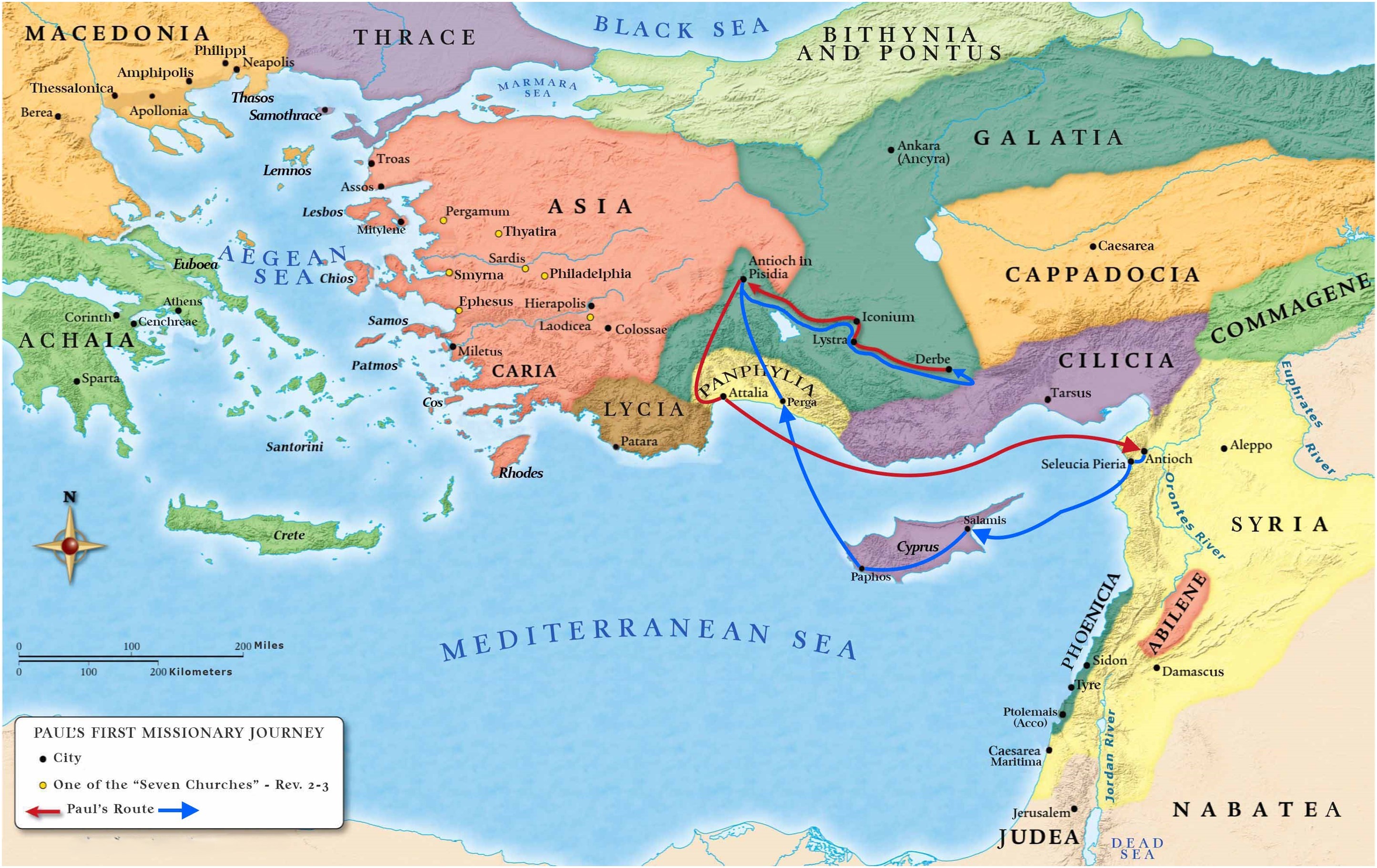
Paul’s first missionary journey is described in Acts 13:1–14:28. The Holy Spirit calls the church in Antioch to “set apart for me Barnabas and Saul for the work to which I have called them.” After fasting and prayer, the church sends out Paul and Barnabas (who also take along John Mark). The journey followed the following route:
After leaving Antioch (Acts 13:1–3), they travel to Seleucia (Acts 13:4) to Salamis (Acts 13:5) to New Paphos (Acts 13:6–12) to Perga of Pamphylia (Acts 13:13; John Mark leaves the mission) to Antioch of Pisidia (Acts 13:14–52) to Iconium (Acts 14:1–7) to Lystra (Acts 14:8–20) to Derbe (Acts 14:20). After Derbe, Paul and Barnabas double back to visit the same towns again and appoint elders in Lystra, Iconium, and Pisidian Antioch (Acts 14:21–23). They then travel to Perga and Attalia (Acts 14:25) and finally back to Antioch (Acts 14:26–28).
________________________________________________
Second missionary journey.
Paul’s second missionary journey is recorded in Acts 15:36–18:22. Shortly after the Jerusalem council, Paul and Barnabas decide to return and visit the churches in every city where they had proclaimed the word of the Lord (Acts 15:36). Paul and Barnabas sharply disagree over taking John Mark with them again to the point that they part ways; Paul instead takes Silas with him, and Barnabas sails for Cyprus with John Mark.
Some of Paul’s most memorable encounters happen on this journey. In Lystra, Paul meets Timothy and invites him to join his missionary team (Acts 16:1-3). Timothy would be one of Paul’s most trusted fellow-workers (Rom 16:21; 1 Cor 4:17; Phil 1:1; Col 1:1; 1 Thes 1:1; Philemon 1:1; 1-2 Timothy). Passing through Asia to Troas, Paul receives a vision of a man from Macedonia calling him to cross the Aegean sea. Soon after, Paul and his companions set sail for the Macedonian region (Acts 16:8-10). In Philippi, Paul casts a fortune telling spirit out of a slave girl, which enrages her masters to the point they get Paul and Silas put in jail (Acts 16:16-24). An earthquake from the Lord frees Paul and Silas who choose to witness to the jailer rather than flee (Acts 16:25-40). After further travel, Paul eventually arrives in the Greek city of Corinth and spends about a year a half there. Paul most likely wrote his two letters to the church of Thessalonica during this stay at Corinth. Paul also meets Priscilla and Aquila, who become a trusted ministry couple for years to come (Acts 18:18-26; Rom 16:3; 1 Cor 16:19; 2 Tim 14:9).
The second missionary journey went along the following route: After leaving Antioch, Paul and Silas travel to Syria and Cilicia (Acts 15:41) to Derbe and Lystra (Acts 16:1–5) through the Phyrgian and Galatian region (Acts 16:6) to Mysia (Acts 16:7–8) to Troas (Acts 16:8–10). By boat they went to Samothrace (Acts 16:11) and on to Neapolis (Acts 16:11). Once again on land, they travelled to Philippi (Acts 16:12–40; 1 Thess 2:2; Phil 4:15). They then went through Amphipolis and Apollonia (Acts 17:1) on the way to Thessalonica (Acts 17:1–9; 1 Thess 2:1–10; Phil 4:16) to Berea (Acts 17:10–14) to Athens (Acts 17:15–34; 1 Thess 3:1–6) to Corinth (Acts 18:1–17; 1 Cor 3:6). Paul then headed back by boarding a ship at Cenchrea (Acts 18:18) and sailed to Ephesus where he left Priscilla and Aquila (Acts 18:19–21) and then sailed on to Caesarea (Acts 18:22). From Caesarea, Paul and Silas probably went to Jerusalem before eventually returning to the church in Antioch.

__________________________________________________
Third missionary journey
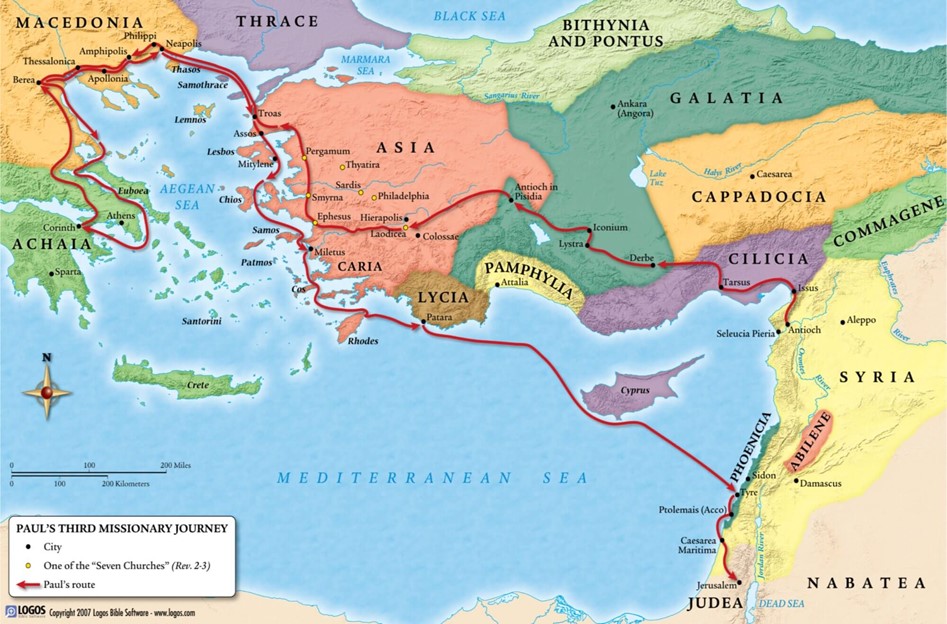
Acts 18:23–21:16 describes Paul’s third missionary journey, which once again departs from Antioch. After encouraging the churches in Galatia and Phyrgia, Paul arrived in Ephesus, where he successfully ministered for about three years (Acts 19). Threats and violence from those who made idols of the goddess Artemis caused Paul to finally leave. During his stay in Ephesus, Paul most likely wrote his first letter to the Corinthians, and sometime later his second letter to the Corinthians in response to a report from Titus (2 Cor 7:6, 13; 8:16-23). From Ephesus, Paul visited Macedonia and went on to Greece. Paul stayed three months in Greece, mostly likely in Corinth the majority of the time where he wrote the epistle to the Romans. On the return trip to Jerusalem, Paul went through Macedonia again, visiting Philippi. After sailing from Troas to Miletus, the elders of the Ephesian church met with Paul for the last time (Acts 20:17-38). From there, Paul and his companions traveled to Caesarea by boat, making several stops along the way (Acts 21:1-8). After a short stay in Caesarea, Paul and others made the pilgrimage to Jerusalem for the feast of Pentecost and for Paul to fulfill his oath (Acts 21:15-26).
We can trace the third missionary journey through the following places: Paul and his companions went through Galatia and Phyrgia strengthening disciples (Acts 18:23) and on to Ephesus, where Paul stayed 3 years (Acts 19:1–40; 1 Cor 16:8). After the stay in Ephesus, they went through Macedonia strengthening the churches on their way to Corinth/Greece (Acts 20:2), where they stayed 3 months. As they headed back to Syria/Jerusalem they once again passed through Macedonia/Philippi (Acts 20:3–6a). From Philippi they sailed to Troas where Paul raised the boy who fell out a window (Acts 20:6b–12). They then sailed to Assos, Mitylene, Chios, Samos (Acts 20:13–15) and on to Miletus (Acts 20:16–38). After meeting with the Ephesian elders in Miletus, they sailed to Cos, Rhodes, Patara (Acts 21:1–2) and on to Tyre (Acts 21:3) to Ptolemais (Acts 21:7) to Caesarea (Acts 21:8–14) and finally to Jerusalem (Acts 21:15, 17–26).
______________________________________________________
Journey to Rome
After his arrest for causing a disturbance in the temple, Paul remains in custody for at least two years awaiting trial. During this time, the Jewish leaders accuse and plot to kill Paul, and Paul makes several speeches and appeals before various Roman authorities (Acts 22:22-26:31). All these Roman authorities appear to consider Paul innocent, which may be the author’s way of showing Christianity’s harmlessness to Rome and its citizens. After appealing to Caesar during his trial before the governor Festus (Acts 25:11-12), Paul begins his journey to Rome. The mostly ocean voyage takes several months due to a shipwreck on the island of Malta. After finally arriving in Rome, Acts 28:30-31 states that Paul proclaimed the gospel without hindrance for two years as he awaited trial. The book of Acts ends with this statement of Paul’s bold proclamation of the gospel in Rome, which was a fitting fulfillment of Jesus’ commission (Acts 1:8) to be his witnesses to “the ends of the earth.” From his letter to the Philippians, we learn that Paul even had opportunity to spread the gospel among the imperial guards, and to Caesar’s household (Phil. 1:12-13; 4:22). In addition to his epistles to the Philippians, Paul also probably wrote his epistle to the Colossians, Ephesians, and to Philemon during his Roman imprisonment.
Very early tradition suggests that Paul was released after this imprisonment (1 Clement 5:5–7; Eusebius, Ecclesiastical History 2.22) and continued even further west on another missionary journey. During this period of freedom, Paul probably wrote First Timothy and Titus. Not long after his release, Emperor Nero blamed the great Roman fire on Christians. A severe persecution broke out against the Christians, which probably resulted in Paul’s re-arrest and transfer to Rome. During this imprisonment Paul wrote his last letter—Second Timothy. Paul was most likely martyred by Nero sometime in AD 64-66.

___________________________________
End Notes
Bock, Darrell. Acts. BECNT; Grand Rapids: Baker Academic, 2007.
Lenski, R. The Interpretation of the Acts of the Apostles. Minneapolis: Augsburg, 1961.
Parsons, M. Acts. Grand Rapids: Baker Academic, 2008.
Schreiner, Patrick. Acts. Christian Standard Commentary. Holman Publishing, 2021.
 throughandto